
Good morning. It’s Thursday, Sept. 10.
- AI warning sparks calls for action in Washington.
- Salmon surge into historic habitat in Klamath River.
- And the curious trend of walking cats in Los Angeles.
Statewide
1.
A former United Farm Workers volunteer sued two nonprofits tied to Cesar Chavez last week, accusing them of failing to protect her from sexual abuse by the late labor leader. The woman, who is 86 and identified as Jane Doe, said Chavez sent her husband away on union business in 1973, then pursued her aggressively at a party. When she rebuffed him, the suit alleged, Chavez lay in wait at her home then raped her while his bodyguard stood watch outside. UFW employees knew of the abuse but sought to conceal it, she said. N.Y. Times | L.A. Times
Northern California
2.
An Anthropic researcher’s warning on Tuesday about the existential threat posed by artificial intelligence sent a shiver of panic through Congress. Lawmakers in both parties are now escalating pleas for legislative action. “We cannot stick our heads in the sand and pretend this technology isn’t happening,” Ted Cruz, a Republican senator, said on Wednesday. Rep. Don Beyer, a Democrat, said “we’re finally hitting a tipping point.” He added: “Now the question is, what do we do?” Politico | Washington Post
- How would AI kill us all? In one scenario, a malevolent AI system could decide to spread a bioweapon. But there are a “million ways,” one researcher said. S.F. Chronicle | Wall Street Journal
3.

Two years after the last of four major dams on Northern California’s Klamath River was breached, salmon have reoccupied 88% of their historic range above the dams’ sites, a new study found. The pace of recovery surpassed even the most optimistic predictions, as some 20,000 chinook salmon migrated up the river for the first time in a century. “Chinook salmon didn’t just trickle back into reconnected habitat in the upper Klamath Basin,” wrote the conservation group CalTrout. “They surged.” Inside Climate News
4.
Brigid Lynch, a geomorphologist, was surveying a preserve in the San Mateo County hills recently when she eyed what looked like an odd-looking rock in a creek. She showed it to a paleontologist who identified it as an intact molar from an Pacific mastodon, a massive elephant-like animal that went extinct roughly 11,000 years ago. The discovery is being hailed as extraordinary. “The tooth itself is in immaculate condition,” said Wayne Thompson, a paleontologist. “I had chills and shivers up and down my spine.” S.F. Chronicle | Mercury News
5.
The Trump administration on Wednesday accused the UC Berkeley School of Law of discriminating against white and Asian applicants. According to the Justice Department, an investigation found that the school used “race, essay prompts, and other tactics to further its admissions diversity goals.” As a result, Black applicants in 2025 had odds of admission 5.8 times higher than white applicants with similar qualifications, officials said. The finding threatens hundreds of millions of dollars of funding at Berkeley. Bloomberg | L.A. Times
6.

On Wednesday, Apple introduced a foldable iPhone, and at $2,000 it’s the most expensive one yet. The Duo, as its called, is passport-sized and essentially transforms into a mini tablet when unfolded. While reviewers haven’t had much hands-on time with the device, early impressions appeared to be largely positive. Then there’s the price. CNET’s Katelyn Chedraoui accused Apple indulging in corporate greed even though it already enjoys massive profits. “I want an iPhone Duo,” she wrote, “but I refuse to pay that much.”
Southern California
7.
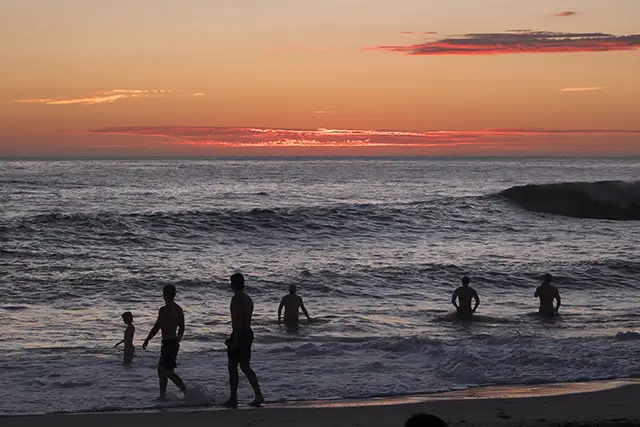
San Francisco: 94
Santa Barbara: 96
Anaheim: 107
Escondido: 112
Numerous daily temperature records were shattered across California on Wednesday, as high humidity made the weather feel even hotter. Forecasters said the misery would repeat on Thursday before temperatures begin to subside on Friday. The heat wave arrived as a sort of punctuation mark: the National Oceanic and Atmospheric Administration confirmed on Wednesday that the U.S. just experienced its hottest meteorological summer ever, averaging 74.4 degrees. L.A. Times |
8.
As coastal communities in Southern California surveyed the damage caused from intense waves fueled by Hurricane Marie, climate scientist Daniel Swain warned on Wednesday that the havoc was just a preview of what’s to come. A looming El Niño is projected to peak between November and January, tilting the odds toward more storms and higher sea levels along the Pacific coast. “It will get worse this fall and especially this winter. … It could be quite significant,” Swain said. L.A. Times | O.C. Register
9.
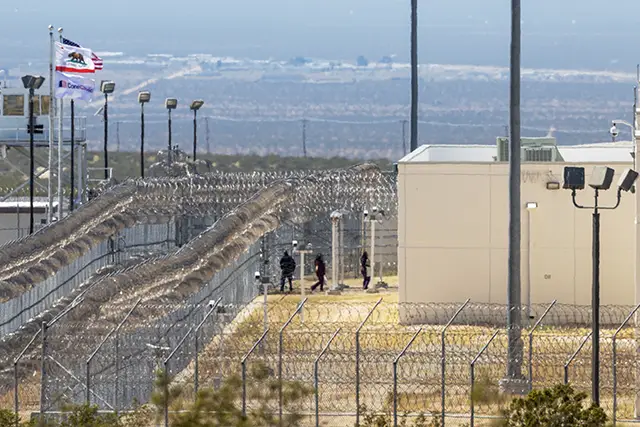
In California’s largest immigrant detention facility, hugging is banned. Even people convicted of serious crimes are typically allowed “contact visits” in U.S. prisons, in which visitors sit with inmates at tables. At California City Detention Facility, however, all visits are conducted through thick glass using phones. It’s no small hardship, said Allen Tayson, a detainee who came to the U.S. as a child from the Philippines. “If I was able to hug and hold my wife and kids, it would be like a brief getaway that would take me away from this setting,” he said. “I’d cherish every second.” The Guardian
10.
After the L.A. Times’ billionaire owner Patrick Soon-Shiong blocked an editorial board endorsement of Kamala Harris in the fall of 2024 and later moved to curtail opinion pieces critical of Donald Trump, an employee exodus resulted. The last board member took a buyout in early 2025. For nearly 18 months, the Times published no editorials — until Sunday, when an editorial appeared urging readers to vote no on California’s proposed billionaire tax. It reads “like something drafted by a campaign comms contractor,” wrote Mariel Garza, the Times’ former editorials editor. Golden State
11.
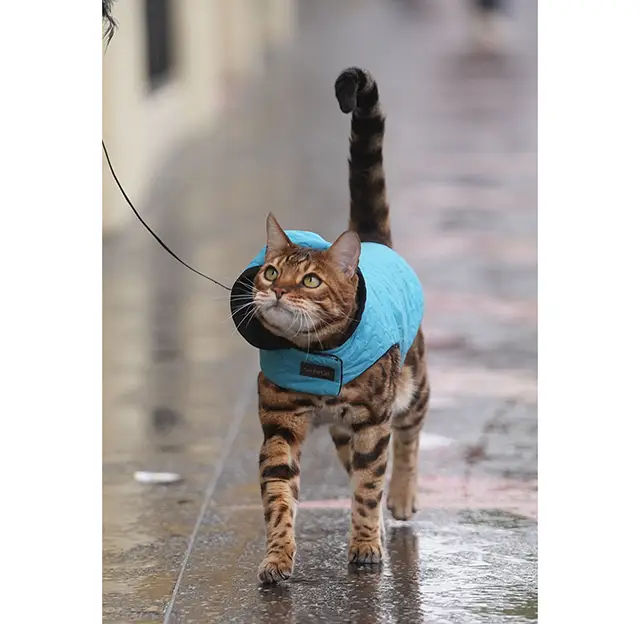
A lot of people walk their cats in Los Angeles. When the L.A. Times asked readers to tell them why they walk their cats, roughly 160 people answered within hours. For many, the outings are about giving their pets a fully enriched life. Julia Luke, who walks her domestic shorthair Gnocchi along the sidewalks of Beverly Grove, said neighbors know her cat’s name before they know hers. “I think about how happy I would be if my whole entire life was inside,” she said. L.A. Times
12.

The writer Eve Babitz attracted a cult following with her rollicking chronicles of 1970s Los Angeles. But she considered her letters to her famous friends “the kind of writing I do best.” A compilation of Babitz’s correspondence has now been published in a new volume, “Too L.A.: Letters Never Sent (but Some Were).” Critics said the writing was sometimes “vapid,” and at other times compelling, unguarded, and akin to “Bridget Jones on acid.” “Dear friend,” begins one missive to an unidentified lover, “sorry I was such a cunt but I couldn’t resist.” AnOther magazine
Get your California Sun T-shirts, phone cases, hoodies, hats, and totes!


The California Sun, PO Box 6868, Los Osos, CA 93412

Wake up to must-read news from around the Golden State delivered to your inbox each morning.